
Maximize Your Investment: The Essential Guide to Battery Charge Cycles & Lifespan

Dec 03, 2025

Have you ever experienced this: after a few years of use, your phone's battery becomes increasingly inefficient, dropping from 100% to half capacity after only a short time? Or, after a few years of driving an electric vehicle, its range noticeably decreases, requiring more frequent charging?


Energy storage batteries, whether for large power plants supporting the grid or residential systems protecting homes, are no exception to this "aging" process.


For commercial and industrial energy storage projects with investments of millions, or for home energy storage systems expected to last for over a decade, a crucial question is: how many charge-discharge cycles can this battery actually withstand?


What is cycle life?

Cycle life, simply put, is how many complete cycles a battery can undergo from full charge to full discharge before it "retires."

"Retirement" here usually refers to its usable capacity decreasing to a certain percentage of its initial capacity, such as 80% or 70%. For example, if a new battery can store 10 kWh, and after repeated charge-discharge cycles it can only store 8 kWh, it is considered to have reached the end of its lifespan, typically around 80%.

Understanding cycle life is crucial for two reasons:

It calculates a "complete charge-discharge cycle," not simply "the number of charges."

For example, charging a battery to 50% and then discharging it accounts for half a cycle. Charging it 50% again and discharging it 50% completes a full cycle. If this complete "charge to discharge" cycle, or equivalent energy throughput, occurs daily, the cycle life figure directly corresponds to the theoretical number of years of use.

The standard for "retirement" varies depending on the scenario.

Commercial and industrial energy storage has high performance requirements, typically defining its lifespan as 80% capacity decay. Residential energy storage requirements may be slightly more lenient, sometimes as low as 70%. This standard directly determines the nominal cycle life value.


How important is cycle life?

Cycle life is far more than just a technical parameter; it profoundly impacts the economic value and user experience of energy storage systems:

For commercial and industrial users: It's the lifeline of return on investment.

The core profit model of commercial and industrial energy storage is peak-valley arbitrage—charging during off-peak hours when electricity prices are low and discharging during peak hours when prices are high. Cycle life directly determines how long this buy-low-sell-high game can last.

For example: An energy storage power station performs one complete charge-discharge cycle per day.

If a lithium iron phosphate battery with a cycle life of 6000 cycles is used, it can theoretically operate for about 16 years (6000 cycles ÷ 365 days ≈ 16.4 years).


However, if in actual use, high temperatures or improper operation shorten the lifespan to 4000 cycles, the theoretical lifespan drops sharply to about 11 years.

This means that the time it takes to recoup the investment and make a profit is significantly shortened, potentially even affecting the feasibility of the entire project.

A longer cycle life means earning more from peak-valley price differences throughout its entire lifespan.


For residential users: It affects peace of mind regarding daily electricity usage.

Residential energy storage users aim for self-consumption, improved green electricity utilization, and emergency backup power. As battery capacity degrades with increasing cycle count, the most direct consequence is reduced energy storage capacity.

For example, a new system might store 10 kWh, sufficient for nighttime electricity needs. After a few years, with capacity reduced to only 7 kWh, it may not be enough to cover all nighttime electricity needs, requiring additional electricity purchases from the grid, reducing independence and economic efficiency. Capacity degradation also means shorter backup time during power outages.


Core Relationship: Cycle Life and Levelized Cost of Energy (LCOE).

This is the gold standard for evaluating the economics of energy storage. Simply put, LCOE is the average cost of energy released over the entire lifespan of the battery system (equipment cost + installation, maintenance + replacement cost) across the total amount of electricity it can release.

Clearly, the longer the cycle life, the more total electricity the battery can release, and the lower the average cost per kWh.

A battery with a cycle life of 10,000 cycles typically has twice the total discharge capacity of a battery with a cycle life of 5,000 cycles. Even if the initial purchase price is slightly higher, its cost per kilowatt-hour may be lower, making it more cost-effective in the long run.


Different Batteries, Different Lifespans

The energy storage battery family comprises many members, each with significantly different cycle lives, requiring a tailored selection:

Lithium Iron Phosphate (LFP) Batteries: Currently the mainstream choice for industrial, commercial, and residential energy storage. One of their biggest advantages is their ultra-long cycle life, generally exceeding 3000 cycles, with high-quality battery pack designs even claiming over 8000 to 10000 cycles. Combined with their good safety and relatively low cost, this makes them the preferred choice for scenarios requiring long-term stable operation and high-frequency charge-discharge (such as daily peak-valley arbitrage in industrial and commercial energy storage).


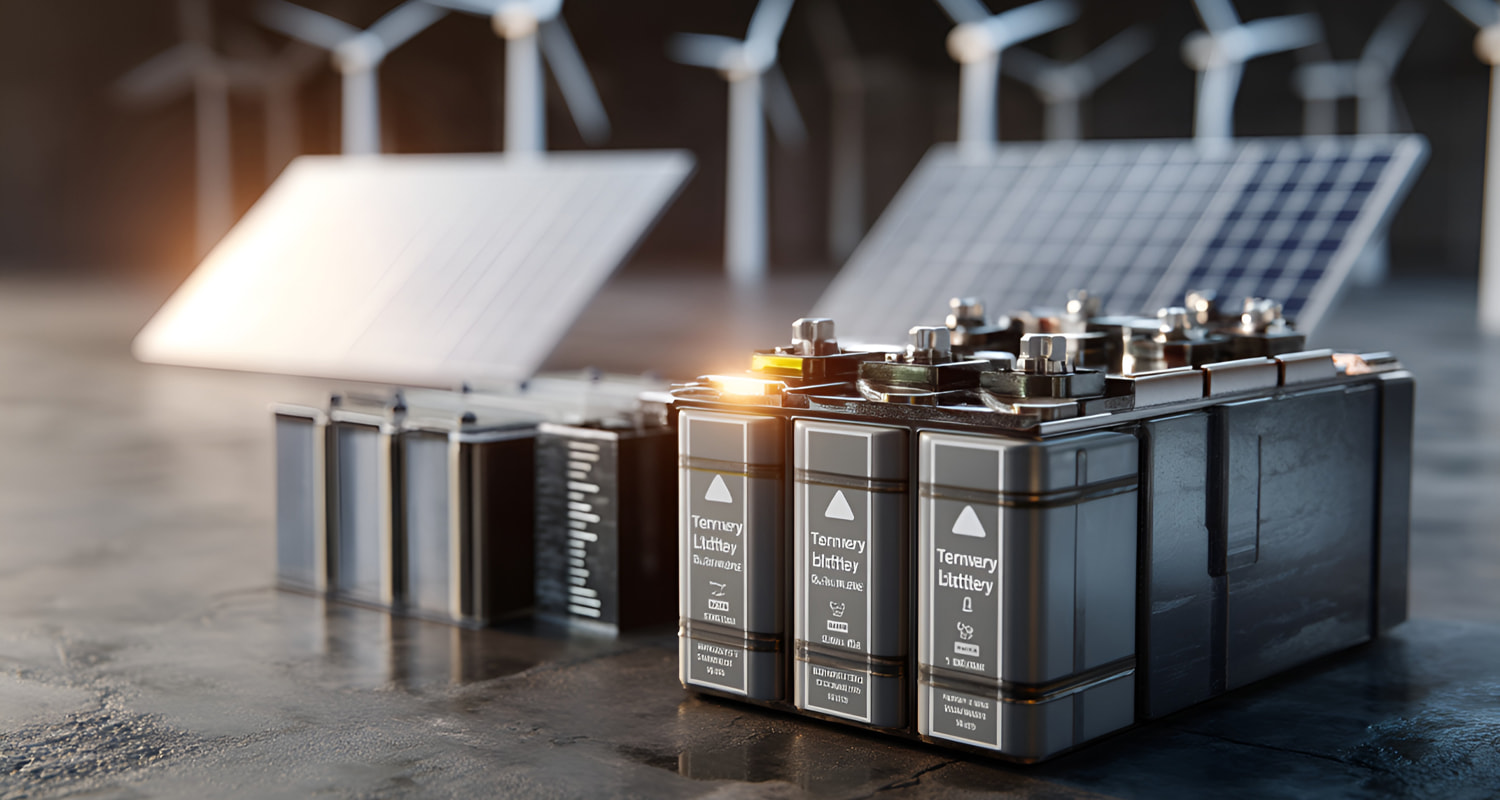
Ternary Lithium Batteries: Higher energy density, meaning they can store more energy in the same volume or weight, often used in space- and weight-sensitive applications (such as electric vehicles and some high-end residential energy storage). However, their cycle life is typically lower than LFP, generally between 1000 and 3000 cycles. This means they are relatively less competitive in stationary energy storage scenarios requiring long lifespan and high cycle counts.


Lead-acid batteries: a traditional technology with the lowest cost, but with significant drawbacks: very short cycle life, typically around 300 to 500 cycles. This means frequent battery replacements are necessary, which is not only inconvenient but also costly in the long run. They are rapidly being replaced by lithium batteries in stationary energy storage, primarily used in cost-sensitive or specific backup scenarios.


Flow batteries: Vanadium redox flow batteries, such as the all-vanadium redox flow battery, are potential candidates for long-term energy storage exceeding 4 hours. Their core advantage is their ultra-long cycle life, generally exceeding 10,000 cycles, and even reaching over 15,000 cycles. The principle is that their active materials are stored in an external electrolyte tank, minimizing electrode wear during charging and discharging. However, their disadvantages are also obvious: low energy density (large system size), high initial cost, and system complexity. They are more suitable for large-scale, ultra-long-term energy storage needs on the grid side.

留言

留言
如果您对我们的产品感兴趣并想了解更多详情,请在此留言,我们会尽快回复您。
提交

首页

产品

whatsapp

接触